News
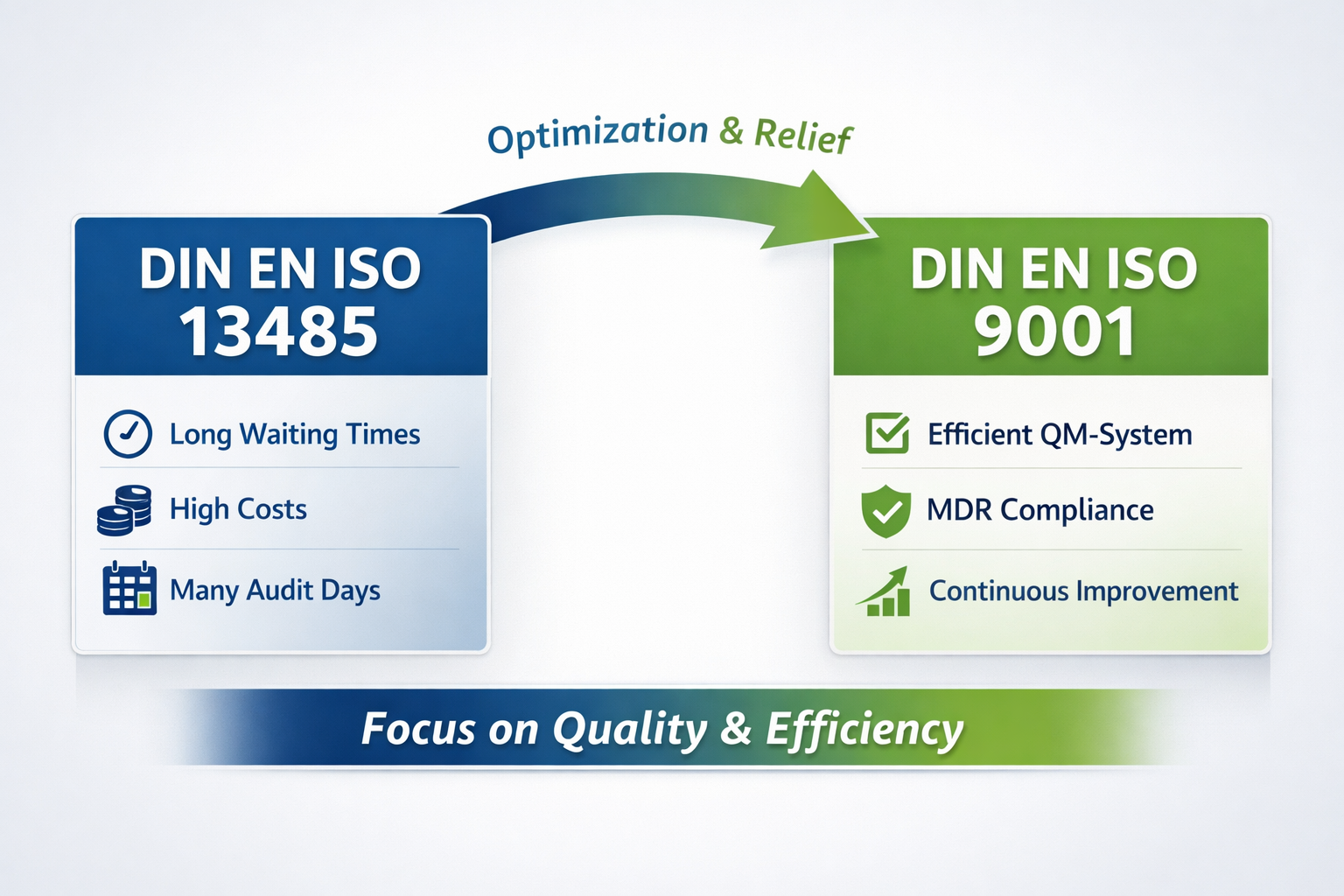
Change of standard from DIN EN ISO 13485 to DIN EN ISO 9001
Reasons for the transition from DIN EN ISO 13485 to ISO 9001
As a manufacturer of Class I (non-sterile) medical devices, we have decided, after careful consideration, to switch our certification from DIN EN ISO 13485 to ISO 9001. This decision is primarily based on organisational, economic and structural considerations, without compromising the quality, safety or regulatory compliance of our products. We were successfully audited to DIN EN ISO 9001 last week and will publish the certificate online as soon as it is issued.
In recent years, the following points in particular have increasingly proved to be a hindrance:
Given that we manufacture exclusively Class I (non-sterile) medical devices, we have assessed the extent to which ISO 9001 certification, whilst maintaining all regulatory requirements, represents an appropriate and more economically viable alternative.
It should be emphasised that:
The transition to ISO 9001 is therefore not intended to lower quality standards, but rather to optimise efficiency, cost-effectiveness and organisational agility.
We continue to consistently pursue the long-standing approach of a structured, process-oriented and risk-based quality management system. The continuous improvement of our processes, products and services remains a central component of our corporate philosophy.
In summary, the transition to ISO 9001 represents a factually justified, risk-appropriate and economically sound decision for our company, one that fully meets both regulatory requirements and our own quality standards.
We are happy to answer any questions you may have regarding our decision.
In recent years, the following points in particular have increasingly proved to be a hindrance:
- Disproportionately long waiting times for audit appointments, which have made reliable planning and the continuous development of the system difficult
- Significantly increased certification costs, some of which are no longer transparently traceable;
- A high and ever-increasing audit burden (number and duration of audit days), which is disproportionate to the risk class of our products_
Given that we manufacture exclusively Class I (non-sterile) medical devices, we have assessed the extent to which ISO 9001 certification, whilst maintaining all regulatory requirements, represents an appropriate and more economically viable alternative.
It should be emphasised that:
- The structure and focus of our IT-supported quality management system will continue to be aligned with the requirements of DIN EN ISO 13485
- All requirements of the MDR (EU 2017/745) will continue to be fully met
- Processes such as risk management, documentation, traceability, market surveillance and complaint management remain firmly established
The transition to ISO 9001 is therefore not intended to lower quality standards, but rather to optimise efficiency, cost-effectiveness and organisational agility.
We continue to consistently pursue the long-standing approach of a structured, process-oriented and risk-based quality management system. The continuous improvement of our processes, products and services remains a central component of our corporate philosophy.
In summary, the transition to ISO 9001 represents a factually justified, risk-appropriate and economically sound decision for our company, one that fully meets both regulatory requirements and our own quality standards.
We are happy to answer any questions you may have regarding our decision.
18.03.2026
Share this page